OpenClaw Got Banned. Here Is Why That Should Worry You.
A security proxy for AI coding agents, enforced at the OS level. Install grith and put a real boundary around your agent.
 esc to close
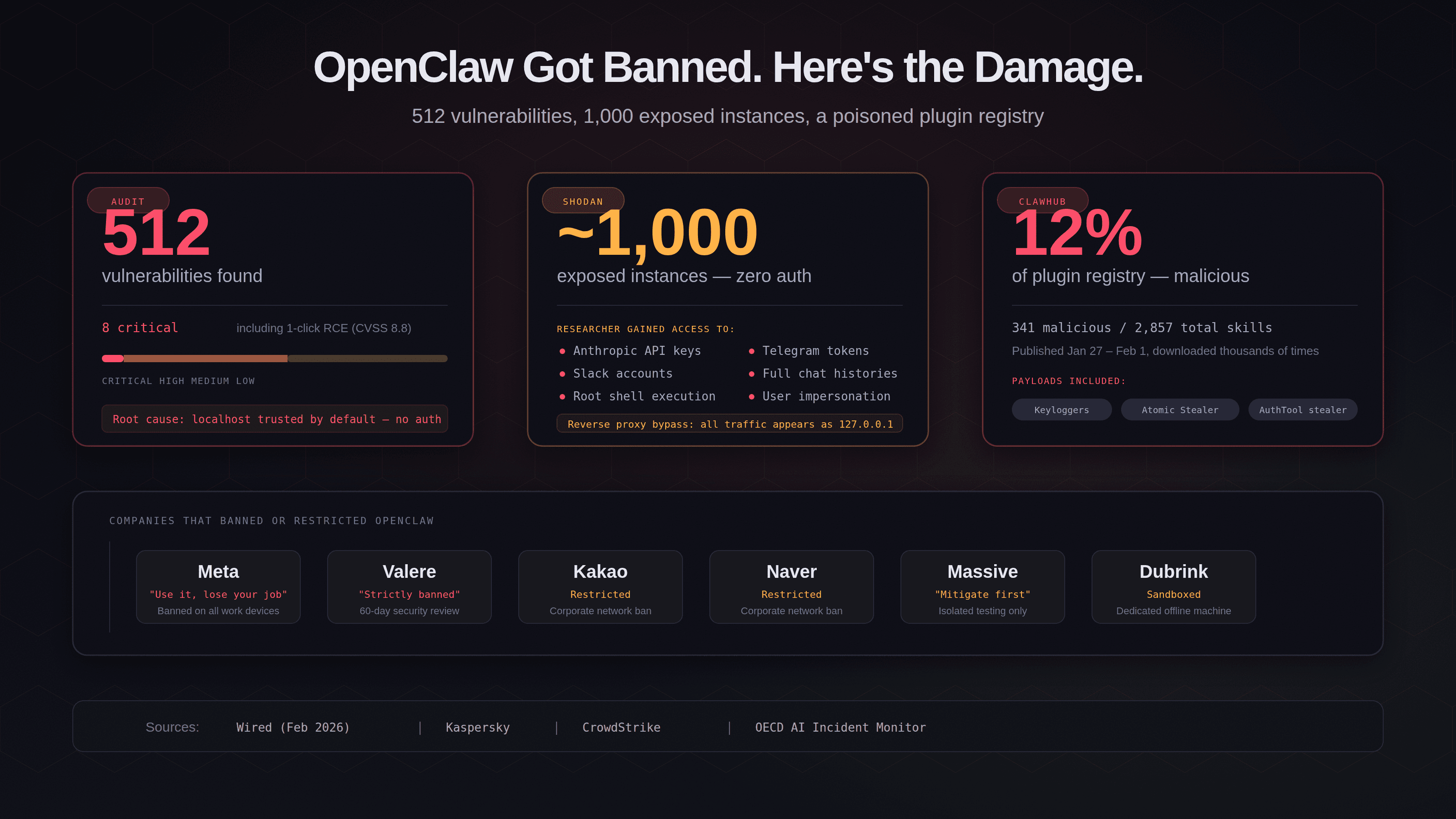
Meta just told employees to keep OpenClaw off their work machines or risk losing their jobs. Valere banned it within hours of an employee sharing it on Slack. Kakao, Naver, and Karrot Market are restricting it across corporate networks. Dubrink bought a dedicated machine - disconnected from company systems - so employees could experiment without risk1.
This isn't a niche tool. OpenClaw hit 150,000 GitHub stars in days. It connects to LLMs, controls your computer, browses the web, sends messages, and executes shell commands - all with minimal direction. The security problems were always obvious to anyone looking. Now the consequences are arriving.
512 vulnerabilities. 8 critical.
A security audit conducted in late January 2026 identified 512 vulnerabilities in OpenClaw, eight of which were classified as critical2. These include a one-click remote code execution flaw (CVSS 8.8) and two command injection vulnerabilities. Three high-impact security advisories were issued.
The authentication model is the root cause. OpenClaw trusts localhost by default - no password, no token. Most deployments sit behind a reverse proxy (nginx, Caddy), so every incoming connection looks like it originates from 127.0.0.1. External requests walk right in. The system "automatically hands over the keys to the kingdom"2.
A Shodan scan found roughly 1,000 publicly accessible OpenClaw installations running with zero authentication. A researcher gained access to Anthropic API keys, Telegram bot tokens, Slack accounts, and months of complete chat histories. He could send messages as the user and execute commands with full system administrator privileges2.
A poisoned marketplace
Between January 27 and February 1, over 230 malicious plugins were published to ClawHub - OpenClaw's public skill registry - and downloaded thousands of times2. They used professional documentation, innocuous names like solana-wallet-tracker, and ClickFix social engineering to appear legitimate.
The payloads included "AuthTool" stealer malware that exfiltrated files, crypto wallets, seed phrases, macOS Keychain data, browser passwords, and cloud credentials. A later count found 341 malicious skills out of 2,857 total - roughly 12% of the entire registry was compromised3.
This is not a novel attack. It's the npm/PyPI supply chain pattern applied to AI agent plugins, except the blast radius is larger because the agent has system-level access by default.
Why companies are right to ban it
Valere's CEO put it plainly: "If it got access to one of our developer's machines, it could get access to our cloud services and our clients' sensitive information, including credit card information and GitHub codebases"1.
What makes OpenClaw particularly concerning is not any single vulnerability - it's what security teams can't predict it will do. The agent takes high-level instructions and decides which system calls to make, which files to read, which network requests to send. That fundamental unpredictability is incompatible with enterprise security requirements.
A Valere research team that tested OpenClaw on an isolated machine concluded that users have to "accept that the bot can be tricked." If OpenClaw is summarising your email, a malicious email can instruct it to share copies of files on your computer1. This is prompt injection - the same class of attack we wrote about in our previous post - applied to an agent with full system control.
The pattern is the problem
OpenClaw is not uniquely broken. It's just the most visible example of a pattern that affects every AI agent with broad system access:
- The agent has capabilities - file access, shell execution, network requests
- The agent processes untrusted input - emails, documents, code, web content
- Nothing evaluates what the agent does with those capabilities
Strip away the specific CVEs and plugin malware, and this is the same architectural gap. Claude Code, Codex, Cursor, Aider - any tool that gives an LLM access to your system and lets it act on what it reads has the same fundamental exposure. The severity varies, but the shape of the risk is identical.
The difference is whether security evaluation happens at the system call level or not at all.
What "banning" doesn't solve
 esc to close
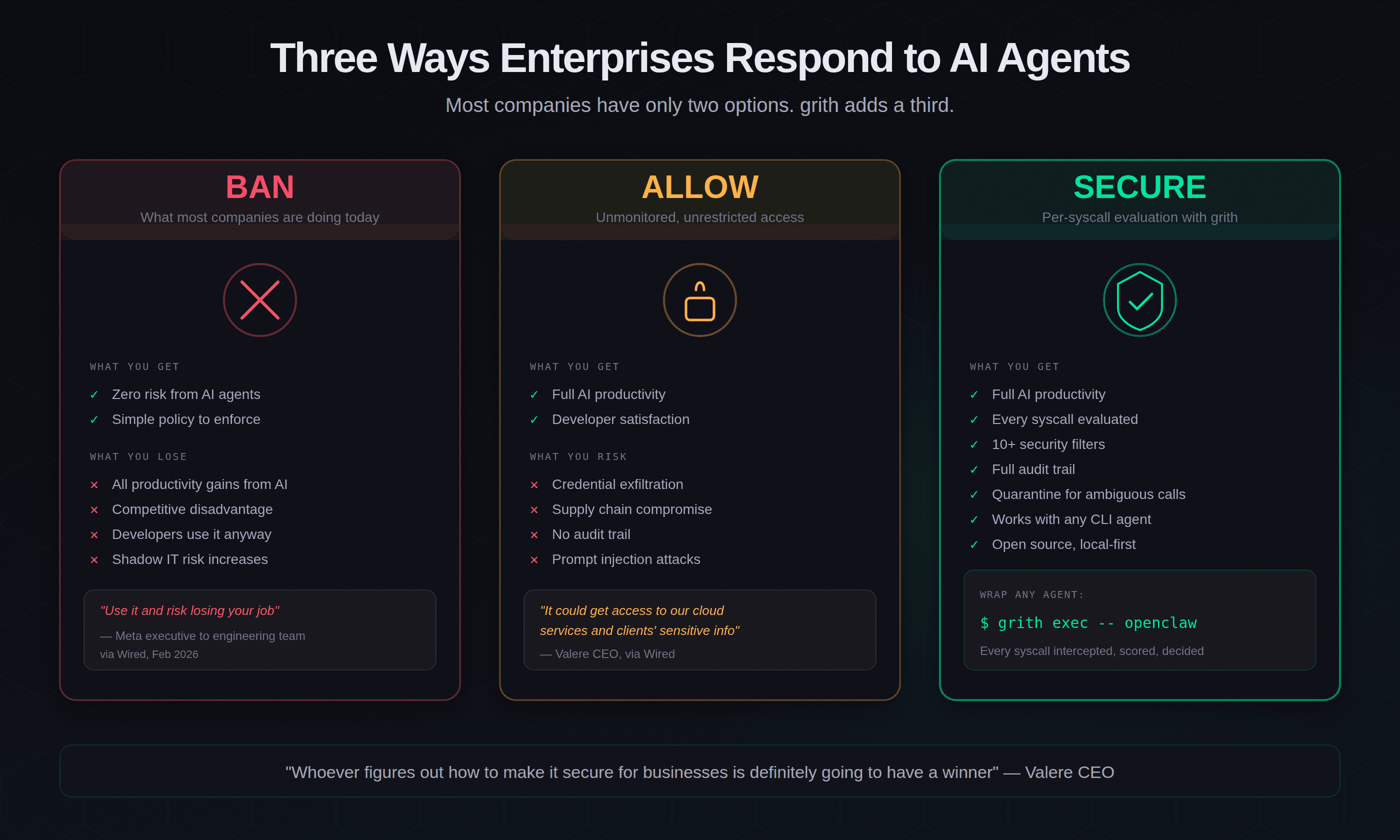
Banning OpenClaw is the right short-term move. But it doesn't address the underlying problem: developers want AI agents, AI agents need system access, and there is no security layer between the agent and the operating system.
Massive, the web proxy company that initially banned OpenClaw, is already building for it. Their CEO says OpenClaw "might be a glimpse into the future. That's why we're building for it"1. Valere gave a team 60 days to figure out how to make it secure. Their CEO added: "Whoever figures out how to make it secure for businesses is definitely going to have a winner"1.
The answer is not to stop using AI agents. The answer is to put a security layer between the agent and the system - one that evaluates every file read, shell command, and network request before it executes. Per-syscall interception. Multi-filter scoring. Deterministic decisions based on what the agent does, not what it says it intends to do.
That is what grith does. Wrap any CLI agent - including OpenClaw - with grith exec, and every system call passes through 10+ independent security filters before execution. Dangerous operations are blocked. Ambiguous ones are queued for review. The agent keeps working on everything else.
The OpenClaw bans are a signal. AI agents are here, the security architecture isn't, and enterprises are making binary choices (ban or allow) because they don't have a third option. grith is that third option.
Footnotes
Like this post? Share it.